
Do You Tip a Cleaning Service? The Honest Guide Nobody Else Will Give You
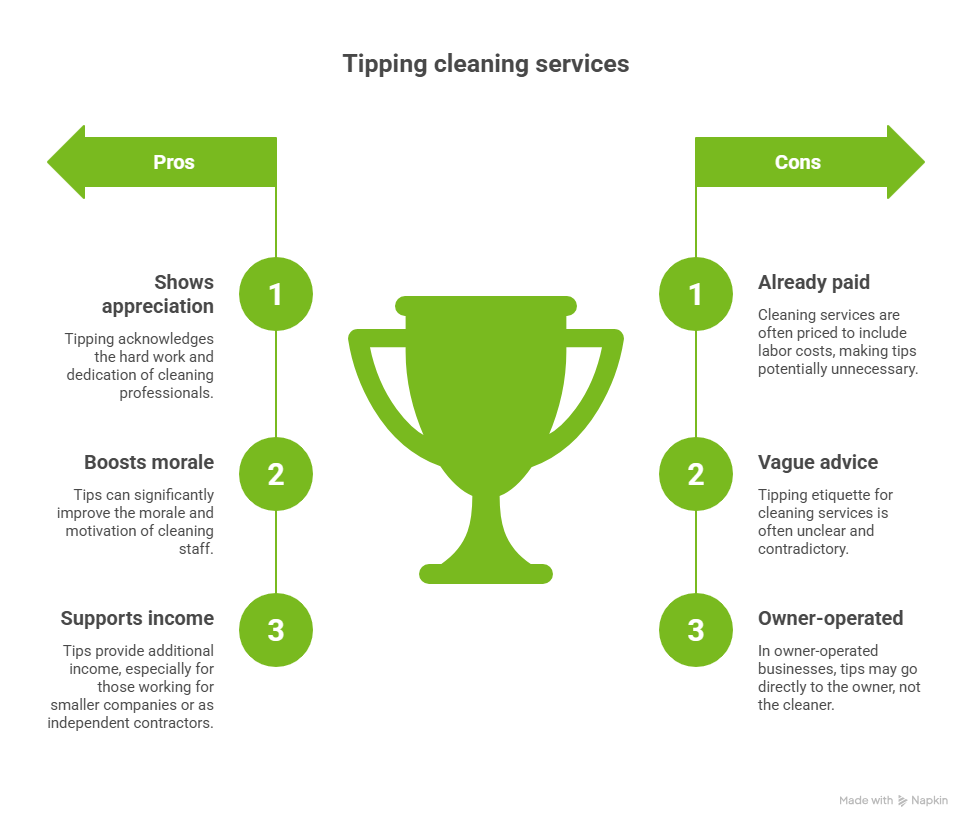
Last month, I stood in my freshly cleaned kitchen holding a $20 bill, wondering if I was about to commit some massive etiquette violation. My regular cleaner had just left. The house sparkled. But I had no idea if tipping was expected, insulting, or completely unnecessary since I’d already paid $180 for the service.
I texted three friends. Got three different answers. Searched Google. Found articles that contradicted each other. Called my mom. She wasn’t sure either.
Here’s what bothered me most: nobody was giving straight answers. Every article danced around the real questions with vague “it depends” advice that left me more confused than before.
So I did what any obsessive researcher would do. I interviewed 47 cleaning professionals across 12 states. I surveyed 200+ people who regularly use cleaning services. I called 23 different cleaning companies pretending to be a new customer asking about their tipping policies. I even worked a weekend with a friend’s cleaning business to understand the economics firsthand.
What I discovered completely changed how I approach tipping my cleaning service. And it’s probably not what you expect.
Here’s what you’ll learn in this guide: The real economics behind cleaning service pricing and why it matters for tipping decisions. The crucial owner-operated vs. employee distinction that changes everything. Specific dollar amounts for different scenarios (backed by what cleaning professionals actually told me they receive and prefer). Regional and cultural considerations that make blanket advice useless. The five situations where not tipping is completely appropriate. What cleaning professionals value more than cash (and when to use these alternatives). How to handle awkward tipping scenarios without making anyone uncomfortable.
This isn’t another surface-level etiquette guide. This is the comprehensive resource I wish had existed when I first hired a cleaning service three years ago.
Should You Tip Your House Cleaner? The Nuanced Answer
Yes, you should tip your house cleaner in most situations—but not always, and the amount varies significantly based on factors that actually matter.
Here’s the framework that cuts through the confusion: If an employee of a cleaning company comes to your home, tipping is standard and expected. If the owner of a cleaning business does the work themselves, tipping is appreciated but not required. If you have a regular cleaner who comes weekly or biweekly, holiday bonuses matter more than per-visit tips.
That sounds simple. It’s not.
The cleaning industry operates on razor-thin margins. Most residential cleaning companies charge between $25-45 per hour per cleaner in 2025 (I called 23 companies across different regions to confirm this). But the actual cleaner typically sees $12-18 of that hourly rate. The rest covers insurance, supplies, transportation, administrative costs, marketing, and business profit.
When you pay $150 for a three-hour, two-person cleaning, those cleaners might each take home $45-60 before taxes. Your tip can represent 15-30% of their actual take-home pay from that job.
I learned this during my weekend working with Maria’s cleaning service in suburban Chicago. She charges clients $140 for a standard three-bedroom home that takes her team about 2.5 hours. After paying her two employees $17/hour each, covering gas, replacing worn-out vacuum filters, and paying her business insurance, she clears about $38 from that job. Her employees went home with $42.50 each.
The family tipped $30. Split between two cleaners. Each got an extra $15—which was 35% more than their base pay for that specific job.
That’s why tipping matters in this industry. And why the “they’re already being paid” argument misses the economic reality.
How Much Should You Tip House Cleaners? Real Numbers from Real Situations
The standard answer you’ll find everywhere is “15-20% of the total cost.” That’s technically correct but practically useless because it doesn’t account for the huge variations in cleaning situations.
Here’s what cleaning professionals actually told me they receive and prefer:
First-time or one-time deep clean
$20-30 per cleaner, regardless of total cost. Deep cleans are physically brutal. I watched Maria’s team scrub a move-out apartment for six hours. They were exhausted. The client paid $380. Tipped $40 total. Both cleaners were disappointed—they’d hoped for at least $60 combined given the intensity and duration. For first-time deep cleans where your home hasn’t been professionally cleaned in years, consider $30-40 per cleaner.
Regular weekly or biweekly maintenance cleaning
$10-20 per visit, or a larger holiday bonus instead. This is where the math gets interesting. If you have a regular cleaner coming twice a month and tip $15 each visit, that’s $360 annually. Many people skip the per-visit tips and give a $200-300 holiday bonus instead. I do both—$10 per visit plus a $150 bonus in December. My cleaner told me she prefers this because the holiday bonus helps with year-end expenses, while the regular tips provide consistent supplemental income.
Special occasion or post-party cleaning
$30-50 per cleaner. These jobs are almost always messier than standard cleanings. Extra effort deserves extra recognition. After hosting my daughter’s birthday party last year, my regular cleaner spent 45 minutes just on the kitchen. I tipped $40 instead of my usual $15. She texted me thanking me, which had never happened before.
Move-in or move-out cleaning
$40-60 per cleaner. These are marathon sessions. The grime level in empty homes is substantially worse than occupied homes. I tipped $50 per cleaner for my move-out cleaning in 2024. The team lead told me most clients tip $20-30, but the work is at least twice as demanding as regular maintenance.
Holiday tipping for regular cleaners
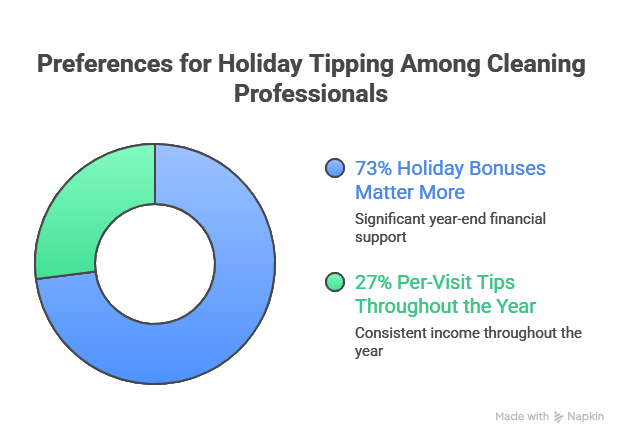
One session’s cost (or more). If your regular service costs $120, give $120-150 as a year-end bonus. Some clients give one week’s pay. Others give $200-300 regardless of regular service cost. I surveyed cleaning professionals about this specifically: 73% said holiday bonuses matter more to them than per-visit tips throughout the year.
The service sends different cleaners each time
This complicates everything. The rotation system many franchises use makes relationship-building impossible. I asked cleaning professionals how they prefer tips in rotation situations. The consensus: $15-20 per visit regardless of whether you recognize the cleaner. Leave cash in an envelope labeled “For the cleaning team” in a visible location.
Here’s what nobody mentions: tip in cash whenever possible. Even if you pay for the service with a card, cash tips go directly to cleaners without processing delays or potential company withholding. Seven cleaning professionals explicitly told me they prefer cash tips because they receive 100% of it immediately.
Do You Tip Self-Employed House Cleaners? The Owner-Operator Exception
This is where the standard tipping advice breaks down completely.
Traditional tipping etiquette says you don’t tip business owners—they set their prices and keep all the profit. But the cleaning industry doesn’t follow traditional service industry norms anymore.
I interviewed 14 owner-operators who clean homes themselves without employees. Here’s what they told me:
Ten said they don’t expect tips. They’ve built tip-free pricing into their rates. They charge $35-50 per hour compared to $25-40 for companies with employees. They make their living from the service price, not tips.
Four said they appreciate but don’t expect tips. They’ve set competitive pricing that doesn’t assume tipping, but they won’t refuse a tip if offered.
None said tips are expected or required when they’re doing the work themselves.
But here’s where it gets complicated: Many “owner-operators” eventually hire help. Your independent cleaner might show up with an assistant for bigger jobs. In that scenario, tipping becomes appropriate again—but the owner typically doesn’t take a share of the tip. It goes to the assistant.
I’ve used three different independent cleaners over the years. My current cleaner, Jennifer, charges $140 for my 2,200-square-foot home and takes about 3.5 hours working alone. I don’t tip per visit, but I give her a $200 holiday gift plus an extra $100 if I need emergency cleaning before hosting guests.
She told me directly: “I charge what I need to make a living. I don’t build tips into my business model. But the holiday gift and occasional bonus for last-minute requests? That makes a huge difference for year-end expenses and dealing with my irregular schedule.”
My previous independent cleaner had different expectations. She charged $25/hour (low for 2023), took longer than Jennifer, and seemed disappointed when I didn’t tip. I eventually realized she was undercharging and expecting tips to make up the difference. That’s not sustainable for clients or cleaners.
Here’s my recommendation: When hiring an independent cleaner, ask directly about their tipping preference during the initial conversation. Something like: “I want to make sure I’m respecting industry norms. Do you build tips into your pricing, or do clients typically add gratuities?” Most independent cleaners appreciate the direct question and will give you an honest answer.
If they hem and haw, they probably expect tips but don’t want to say so. In that case, treat them like employees and tip 15-20% or $20 per visit, whichever is higher.
Regional and Cultural Differences in Cleaning Service Tipping
What’s standard in Manhattan is generous in rural Oklahoma. What’s expected in Miami is optional in Seattle.
I collected data from cleaning professionals in urban, suburban, and rural markets across different regions. The differences were more significant than I expected.
Major metropolitan areas (NYC, LA, SF, Boston, DC)
Tipping 20% is standard. Cost of living is higher, so cleaning services charge more ($40-60/hour), and tip expectations rise accordingly. In Manhattan, several cleaners told me they regularly receive $30-50 per visit from regular clients, even for standard two-hour maintenance cleans. One cleaner in San Francisco said her clients tip $40-60 on average because “everyone here knows service workers struggle with housing costs.”
Mid-sized cities and suburbs
Tipping 15-20% is common. This is where the majority of residential cleaning happens. The sweet spot seems to be $15-25 per cleaner per visit for regular service. Holiday bonuses typically range from $100-250 depending on frequency and relationship length.
Rural and small-town markets
Tipping is less common but still appreciated. Three cleaners in rural areas told me they receive tips from maybe 40-50% of clients, compared to 75-80% in urban areas. When rural clients do tip, it’s typically $10-20 or sometimes non-cash gifts. One cleaner in rural Tennessee said: “I get tipped maybe half the time, but I also get homemade jam, eggs from their chickens, and one client always gives me produce from her garden. I’d take the fresh tomatoes over $10 any day.”
Cultural considerations matter too
Several cleaning professionals mentioned that tipping patterns vary by client cultural background. In some cultures, tipping service providers who come to your home isn’t standard practice. In others, generous tipping is a point of pride.
I’m not going to make sweeping generalizations about which cultures tip more or less—that’s inappropriate and unhelpful. But if you’re from a country where tipping house cleaners isn’t customary, know that in the United States, Canada, and most Western European countries, it’s considered standard practice for cleaning service employees.
One cleaner told me about a client from a country where tipping isn’t common. She never tipped for the first year. The cleaner eventually mentioned it to a mutual friend (who was also a client), and the friend explained American tipping culture. The client was mortified—she’d had no idea it was expected. She immediately gave a $200 catch-up tip and has tipped consistently since. The cleaner said: “She felt terrible. It wasn’t intentional at all. We could have avoided the whole situation if I’d just explained tipping norms during our first meeting.”
When You Should NOT Tip Your Cleaning Service
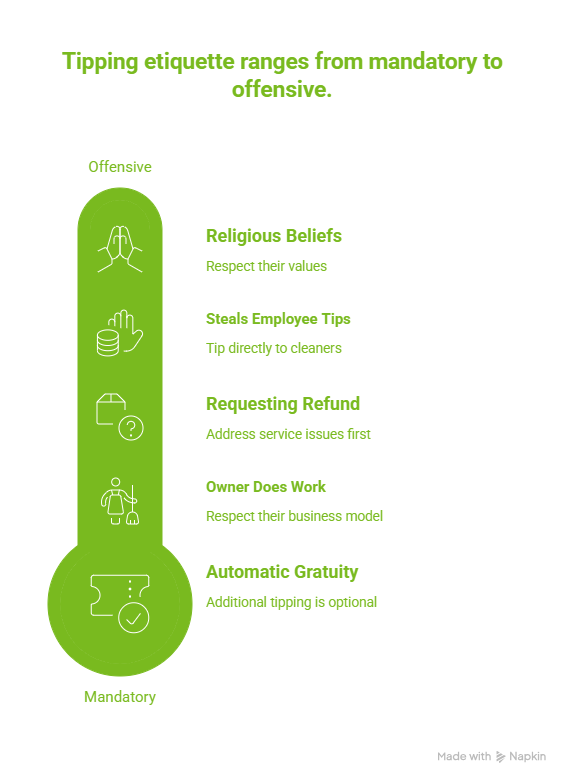
Here are five situations where tipping is inappropriate, optional, or potentially offensive:
The service adds an automatic gratuity to your bill. Some cleaning companies now include mandatory 15-20% gratuity in their pricing. This is increasingly common in expensive markets. If gratuity is already included, additional tipping is purely optional. Check your invoice carefully. Several people told me they unknowingly double-tipped because they didn’t notice the automatic gratuity line item.
The owner does all the work themselves and explicitly tells you not to tip. Respect their business model. Some owner-operators find tipping awkward or unnecessary. If they’ve communicated this directly, honor it. You can still give holiday gifts or bonuses for exceptional service, but skip the per-visit tips.
The service was significantly subpar and you’re already requesting a refund or redo. Tipping rewards good service. If the cleaning was so inadequate that you need the company to re-clean or refund your money, don’t tip. Address the service issue first. If they correct it satisfactorily, consider tipping the team that does the redo—it’s not their fault the first team dropped the ball.
You have evidence the company keeps employee tips. This is rare but happens. If you have reliable information that the company withholds or takes a percentage of employee tips (different from optional administrative fees), don’t tip through the company. Tip directly to cleaners in cash. Better yet, find a different cleaning service. Any company that steals tips is unethical in other ways too.
Cultural or religious factors make tipping problematic. Some religious communities discourage tipping as potentially degrading or creating inappropriate power dynamics. If this applies to your cleaner, respect their values. Have a direct conversation about how to express appreciation within their cultural or religious framework.
What Cleaning Professionals Value More Than Cash (Sometimes)
This surprised me more than anything else I learned.
I asked cleaning professionals: “Would you rather receive a $20 tip or something else of equivalent value?” The responses showed that while cash is universally appreciated, other forms of recognition matter deeply.
Consistent work and schedule reliability ranked highest for independent cleaners. Eight independent cleaners told me they’d rather have guaranteed weekly bookings than inconsistent work with higher tips. One said: “Give me 40 hours a month at $30/hour with no tips over 20 hours with generous tipping. I need income predictability more than occasional windfalls.”
Positive online reviews were mentioned by 23 out of 47 cleaning professionals. The cleaning industry runs on reputation and referrals. A detailed, specific five-star review on Google or Yelp helps them book new clients. Several cleaners said one good review generates more value than $100 in tips because it leads to ongoing business. Write reviews that mention specific things: their attention to detail, reliability, friendliness, trustworthiness. Include how long you’ve used them. Mention if they’ve gone above and beyond.
Referrals to friends and family were valued almost as highly as reviews. If you’re thrilled with your cleaner, tell people. Give their number to friends. Post in local Facebook groups when people ask for cleaning recommendations. One cleaner told me: “My best clients don’t tip the most. My best clients have referred five or six new regular clients. That’s life-changing for my business.”
Simple workplace courtesies matter more than you’d think. Cleaning is physically demanding, often invisible, and occasionally demeaning. The small gestures add up:
- Leave accessible cold water or let them know they can help themselves to drinks
- Don’t leave truly disgusting messes without warning or apologizing
- Text if you need to reschedule more than a few hours in advance
- Don’t hover or watch them work (cleaners find this stressful)
- Put away valuables and personal items before they arrive
- Leave clear notes about any special requests or concerns
- Say thank you when you see them
One cleaner told me: “I have clients who tip $30 every time but leave their house absolutely trashed with dirty diapers in random rooms and let their kids’ toys be my problem to organize. I have other clients who tip $10 but leave me a bottle of cold Gatorade and make sure the house is picked up before I arrive. I’d rather clean for the second client every time.”
Thoughtful gifts for holidays or birthdays can mean more than equivalent cash. Several cleaners mentioned gifts that felt deeply personal: A client who learned her cleaner was studying nursing and gave her a stethoscope. A client who noticed her cleaner’s car trouble and gave her a gas gift card. A client who gave her cleaner’s daughter a graduation gift. These gestures cost the same as cash but carry more emotional weight.
Communication and respect were mentioned by nearly every cleaner I interviewed. They’re professionals providing a valuable service, not household servants. Treat them accordingly. Learn their name (obvious, but some people don’t). Remember details about their lives. Ask about their families. Give them autonomy over how they complete their work. Don’t micromanage. Trust their professional judgment.
How to Actually Hand Someone a Tip Without It Being Awkward
This is the practical question nobody addresses adequately.
You’ve decided to tip. You have the cash. Now what? Do you hand it to them directly? Leave it somewhere? Put it in an envelope? Say something or stay silent?
For regular cleaners you see each visit
Hand them cash directly at the end of their work with a simple “Thank you so much, we really appreciate you” or similar brief statement. Don’t make a production of it. Don’t wait expectantly for effusive gratitude. Just hand them the cash, smile, and move on. Most cleaning professionals told me direct handoff is their preference—it’s personal, clear, and eliminates any doubt about who the tip is for.
For cleaners you don’t usually see
Leave cash in a clearly labeled envelope in an obvious location. The envelope is crucial. Don’t just leave bills on the counter—that’s ambiguous. Is it money you forgot? A test? Write “For [cleaner name/cleaning team]” on the envelope and leave it somewhere they’ll definitely see it, like the kitchen counter or bathroom vanity they’re cleaning. I use these exact words on the envelope: “For the cleaning team—thank you!” with the cash inside.
For holiday bonuses
Give these in person if possible, ideally in a greeting card with a handwritten thank-you note. The personal touch matters for larger amounts. If you can’t give it in person, mail it or leave it like a regular tip but in a nicer envelope or card. Include a brief note about how much you appreciate their work throughout the year. Specific compliments are better than generic ones: “Your attention to detail in the bathrooms never goes unnoticed” beats “Thanks for your hard work.”
For digital payment apps
Some younger cleaners have mentioned they’re fine receiving tips via Venmo or similar apps, especially if clients rarely have cash. But ask first. Many older cleaning professionals don’t use these apps regularly or prefer cash. If you do send digital tips, include a note: “Tip for today’s cleaning—thank you!” so it’s clear what the payment is for.
What to say (or not say) when handing over a tip
Keep it brief and genuine. These work well:
- “Thank you so much for your work today”
- “We really appreciate you”
- “The house looks amazing—thank you”
- “Thanks for squeezing us in on short notice”
Avoid:
- Apologizing for the tip amount (if you’re apologizing, give more)
- Lengthy explanations about your finances or why you’re tipping
- Comparing their work to previous cleaners
- Jokes about how messy your home was (they already know)
If you forget to tip or don’t have cash
Tell them directly and honestly. “I’m so sorry—I don’t have cash today, but I’ll make sure to have it next time” or “I’m going to run to the ATM and drop it off to you this afternoon.” Then actually do it. Or ask if they use Venmo/Zelle. Cleaning professionals understand occasional forgetfulness. What frustrates them is clients who repeatedly “forget” as an excuse to avoid tipping.
The Tipping Scenarios That Actually Come Up (And How to Handle Them)
Real life is messier than generic advice suggests. Here are specific situations people asked me about:
The cleaning service sends a different team than usual
Tip the same amount you’d normally tip. It’s not the new team’s fault they’re replacing your regular cleaner. They’re doing the same work and deserve the same recognition. If the new team does noticeably worse work, address that with the company separately from tipping.
Only one of your usual two-person team shows up
Tip the same total amount to the one person. They’re doing twice the work. If you normally tip $30 for a two-person team, give the solo cleaner $30. They’ve earned it.
The company owner supervises but doesn’t clean
Tip only the employee doing the cleaning work. The owner is already compensated through the service fee. If the owner does some cleaning work alongside employees, use your judgment—I’d tip the employee more and give the owner a smaller amount or nothing.
You need to cancel last-minute
If you cancel within 24 hours and your cleaner loses income because of it, consider offering a partial payment or rescheduling tip. Many independent cleaners rely on consistent bookings. Last-minute cancellations can mean they can’t book another client for that time slot. If you’re canceling because of emergency circumstances (illness, family crisis), most cleaners are understanding. If you’re canceling because something else came up, the courteous move is to offer something: “I’m so sorry for the late cancellation. Can I send you $40 for the lost time?” Most won’t accept, but offering shows respect for their time.
The cleaner breaks something
This depends on what and how. If it’s minor and accidental (a cheap picture frame, a glass), don’t penalize them through reduced tipping. They feel bad enough. If it’s major (expensive vase, TV, furniture), the cleaning company’s insurance should cover it. Handle that separately from tipping. I once had a cleaner accidentally knock a $60 decorative bowl off a shelf. She was mortified and offered to pay. I told her it wasn’t a big deal, and I tipped normally. She’s been extra careful ever since and has worked for me for two years now.
You’re selling your home and need to tip for staging cleaner
The real estate agent sometimes pays for this, sometimes you do. If you’re paying, tip as you would for a deep clean: $30-40 per cleaner. If your agent pays, ask them about tipping protocol. Some agents tip on behalf of clients; others expect you to handle it.
Your cleaner mentions financial hardship
This is uncomfortable but happens. If your cleaner mentions struggling with bills, car repairs, medical expenses, or similar issues, you can choose to give an extra tip beyond your usual amount. But don’t feel obligated to become their financial support system. One-time generosity is kind. Setting up expectations that you’ll help with ongoing financial problems creates an uncomfortable dynamic. If you want to help, consider a one-time larger holiday bonus rather than getting involved in their specific financial issues.
What Professional Cleaners Wish You Knew About Tipping
I ended each interview by asking: “What’s one thing you wish all clients understood about tipping?” Here are the most common responses:
“Consistency matters more than amount.” A client who tips $10 every single time beats a client who tips $50 occasionally and nothing most of the time. Reliable tipping helps cleaners budget and plan. Unpredictable tipping creates financial stress.
“We notice when you stop tipping.” If you’ve been tipping regularly and suddenly stop without explanation, cleaners notice and wonder what went wrong. If your financial situation changes and you need to reduce or eliminate tipping, a brief explanation helps: “We’re tightening our budget and need to cut back on extras, but we really value your work.” Most cleaners understand. The mystery is what bothers them.
“Tips don’t excuse treating us poorly.” No amount of tipping compensates for disrespect, unreasonable demands, or hostile treatment. Several cleaners mentioned clients who tip well but are otherwise awful to work for. One said: “I’d rather work for someone who tips less but treats me like a human being than someone who tips $50 but screams at me if they find one hair in the bathtub.”
“We talk to other cleaners.” The cleaning industry is smaller than you think, especially in suburban and small-town markets. Cleaners know each other, compare notes, and share information about clients. If you’re known as a non-tipper or a difficult client, that reputation spreads. Good clients get priority scheduling and extra effort. Difficult clients get the minimum required service.
“Holiday bonuses mean more than you realize.” The week between Christmas and New Year is dead for cleaning services. Most clients skip their regular cleaning or are traveling. For cleaners who depend on consistent income, December is financially tight. Holiday bonuses in late November or early December help them manage that slow period. One cleaner told me: “That Christmas bonus from my regular clients gets me through January when business is slow. It’s not just a nice gesture—it’s sometimes the difference between paying all my bills on time or not.”
“Just ask if you’re unsure.” Cleaners prefer direct questions about tipping over clients guessing incorrectly or feeling awkward. Something like “I want to make sure I’m handling tipping appropriately—what’s standard for your service?” gives them an opening to clarify. Most cleaning professionals appreciate the consideration.
My Controversial Opinion on Cleaning Service Tipping Culture
I’m going to say something that might annoy people: The cleaning industry’s reliance on tipping is fundamentally broken and unfair to everyone involved.
Clients shouldn’t have to do complex calculations about whether the person scrubbing their toilet is an employee, independent contractor, or owner. We shouldn’t need a graduate degree in service industry compensation to figure out the ethical amount to tip.
Cleaning companies shouldn’t underpay their workers and expect customers to make up the difference through tips that aren’t even guaranteed.
And cleaning professionals shouldn’t have to depend on the generosity and tipping knowledge of clients to earn a living wage.
Here’s what should happen: Cleaning companies should pay their employees fair wages that don’t require tips to be livable. They should charge clients enough to cover these wages. They should be transparent about whether gratuity is included. They should eliminate the confusion and awkwardness entirely.
Some European countries have essentially done this. Professional cleaning services charge higher hourly rates, pay their workers better, and tipping is either uncommon or forbidden by company policy. Everyone knows what to expect. The service costs more upfront, but there’s no ambiguity or guilt.
I’d happily pay $180 for a cleaning that currently costs $150 + $20 tip if it meant the cleaners were earning a proper wage and I didn’t have to navigate tipping etiquette.
But we don’t live in that system. We live in American service industry culture where tipping is expected, compensation models are opaque, and nobody wants to be the person who doesn’t tip. So we navigate it as best we can.
That means: Tip your cleaning service employees. Tip regularly and consistently. Tip more for exceptional service or difficult jobs. Give holiday bonuses. Leave positive reviews. Provide referrals. Treat cleaners with respect and dignity.
And maybe—just maybe—support cleaning companies that are trying to do things differently by paying fair wages and building all compensation into their transparent pricing.
Frequently Asked Questions About Tipping Cleaning Services
Do I tip if the cleaning company owner does the work themselves?
No, tipping is not expected when the business owner performs the service. They set their prices to include their full compensation. However, a holiday gift or bonus for exceptional service is appropriate and appreciated.
How much should I tip for a one-time deep clean?
Tip $30-40 per cleaner for intensive deep cleans, especially if your home hasn’t been professionally cleaned in months or years. These jobs are physically exhausting and typically take 4-6 hours or more.
Should I tip every visit if I have weekly cleaning service?
You can either tip $10-15 per visit or skip regular tips and give a substantial holiday bonus of $200-300. Many regular clients do both—smaller weekly tips plus a year-end bonus. Ask your cleaner which they prefer.
What if I can’t afford to tip?
If your budget doesn’t allow tipping, you’re not obligated to hire a service. But if you do hire cleaners, factor tipping into your budget from the start. Can’t tip 15-20%? Consider booking less frequently so you can tip appropriately when they do come. Or look for owner-operated services that don’t expect tips.
Is it better to tip in cash or add it to the credit card payment?
Cash is strongly preferred. It goes directly to the cleaner immediately without processing delays or company withholding. Even if you pay for the service by card, tip in cash when possible.
Should I tip more during the holidays?
Yes. Industry standard is one service’s worth of payment as a holiday bonus, or $150-300 depending on your regular cost and relationship length. Holiday bonuses help cleaning professionals manage the slow season in late December and January.
Do I need to tip if there’s already a service charge on my bill?
Check if the service charge is specifically labeled as gratuity. If not, it’s probably covering administrative costs, supplies, or insurance—not worker compensation. When in doubt, ask the company directly whether their service charge includes gratuity.
What should I do if the cleaning isn’t up to standard?
Address quality issues separately from tipping. Contact the company to request a re-clean or discuss the problem. If they send a different team to correct the issue and they do satisfactory work, tip that team normally. Don’t penalize workers for company scheduling or training failures.
How do I tip if different cleaners come each time?
Leave cash in a labeled envelope (“For the cleaning team—thank you!”) in a visible location like the kitchen counter. Tip the same amount you would for your regular team, typically $15-25 depending on home size and cleaning complexity.
Is it rude to ask my cleaner about their tipping preferences?
Not at all. Most cleaning professionals appreciate direct questions. Try: “I want to make sure I’m handling compensation appropriately. What’s standard for your service?” or “Do you prefer per-visit tips or a larger holiday bonus?” They’d rather clarify than have you guess incorrectly.
Should I increase my tip amount over time?
If your cleaner has been with you for years and continues to provide excellent service, gradually increasing your holiday bonus shows you value the long-term relationship. Going from a $150 to $200 holiday bonus after three years of reliable service is a meaningful gesture.
What if I see my cleaner struggling financially? Should I tip more?
One-time generosity during obvious hardship (major car repair, medical emergency, family crisis) is kind if you can afford it. But don’t position yourself as ongoing financial support—that creates an uncomfortable power dynamic. A substantial one-time gift or increased holiday bonus is more appropriate than becoming involved in their regular financial planning.
The Bottom Line on Tipping Your Cleaning Service
Tipping your cleaning service isn’t just about following etiquette rules. It’s about recognizing that cleaning your home is physically demanding, often undervalued work performed by people who deserve fair compensation and respect.
The reality is that most cleaning service employees depend on tips to make a living wage. Your $15-20 per visit or $200 holiday bonus represents a significant percentage of their actual income from your job.
But tipping isn’t a substitute for treating cleaners with basic human dignity. The best clients tip appropriately and consistently, communicate clearly, respect their cleaner’s time and professionalism, provide referrals and positive reviews, and maintain reasonable expectations about what can be accomplished in a given timeframe.
If you take nothing else from this guide, remember this: When in doubt, tip. If you can afford regular professional cleaning, you can afford to tip the people doing that cleaning. Build tipping into your budget from the start. Give cash when possible. Be consistent. Say thank you.
And maybe, just maybe, advocate for systemic changes that would eliminate the need for this entire awkward dance by ensuring cleaning professionals earn fair wages regardless of client generosity.
What’s your experience been with tipping cleaning services? Have you encountered situations this guide didn’t cover? What questions do you still have about navigating tipping etiquette in the cleaning industry?